HALOps
HALOps (High-performance Accelerated LLM Operators) is a high-performance operator library for large language model inference, developed by the ERNIE team. The operators are built to exploit NVIDIA GPU hardware features, and use PDL, multi-stream overlap, operator fusion and MegaKernels to remove bubbles between kernels, keeping compute, memory and communication as close to saturation as possible for high-throughput, low-latency inference.
Highlights
HALOps is designed from the ground up for NVIDIA Blackwell (SM100). Built on CUTLASS / CuTe, it uses tcgen05, TMEM and TMA directly and covers the Attention, MoE and MLA hot paths of LLM inference.
GQA attention: variable-length prefill and paged-KV decode across BF16 / FP8 KV cache, GQA and speculative decoding; split-KV parallelism, adaptive reduction and fused pre/post-processing make full use of SM100 compute and bandwidth in long-context and small-batch decode.
Multi-precision GEMM: FP8 (MXFP8) and FP4 (NVFP4 / MXFP4) block-scaled GEMM for dense, batched and MoE grouped workloads; with ultra-lightweight flexible tile configurations and pre-mapped tile scheduling, it delivers industry-leading performance in most scenarios on SM100.
MegaKernel sparse MLA: high-performance MegaKernel sparse attention for HCA and SWA, removing kernel scheduling and intermediate memory round trips, with tile-level pipelining that hides compute and memory latency to push GPU utilization further.
Performance
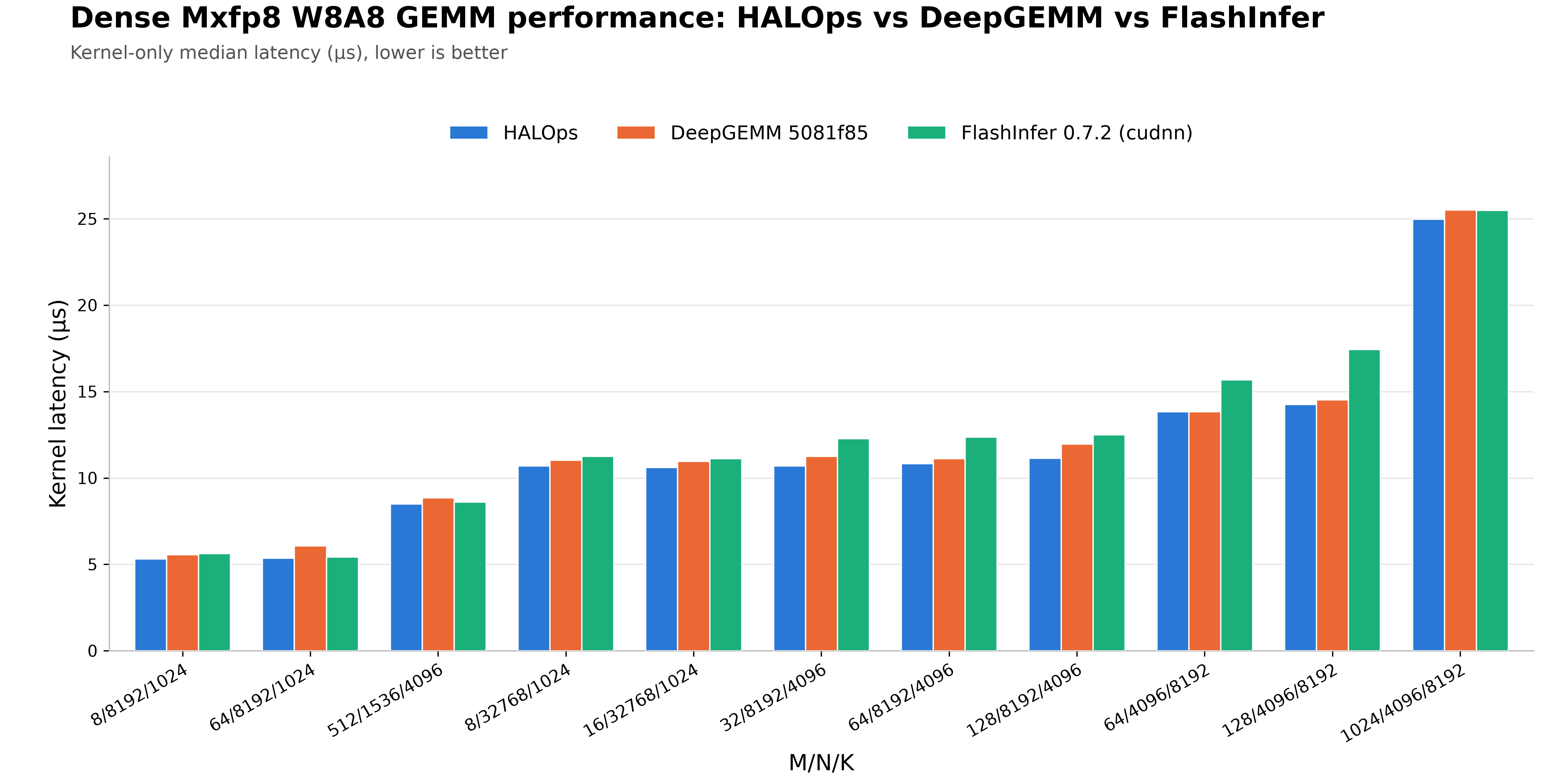
All results are measured on SM100: MXFP8 dense GEMM outperforms DeepGEMM and FlashInfer in some cases, and MegaMLA consistently outperforms the multi-stream + PDL implementation at small concurrency.
 |
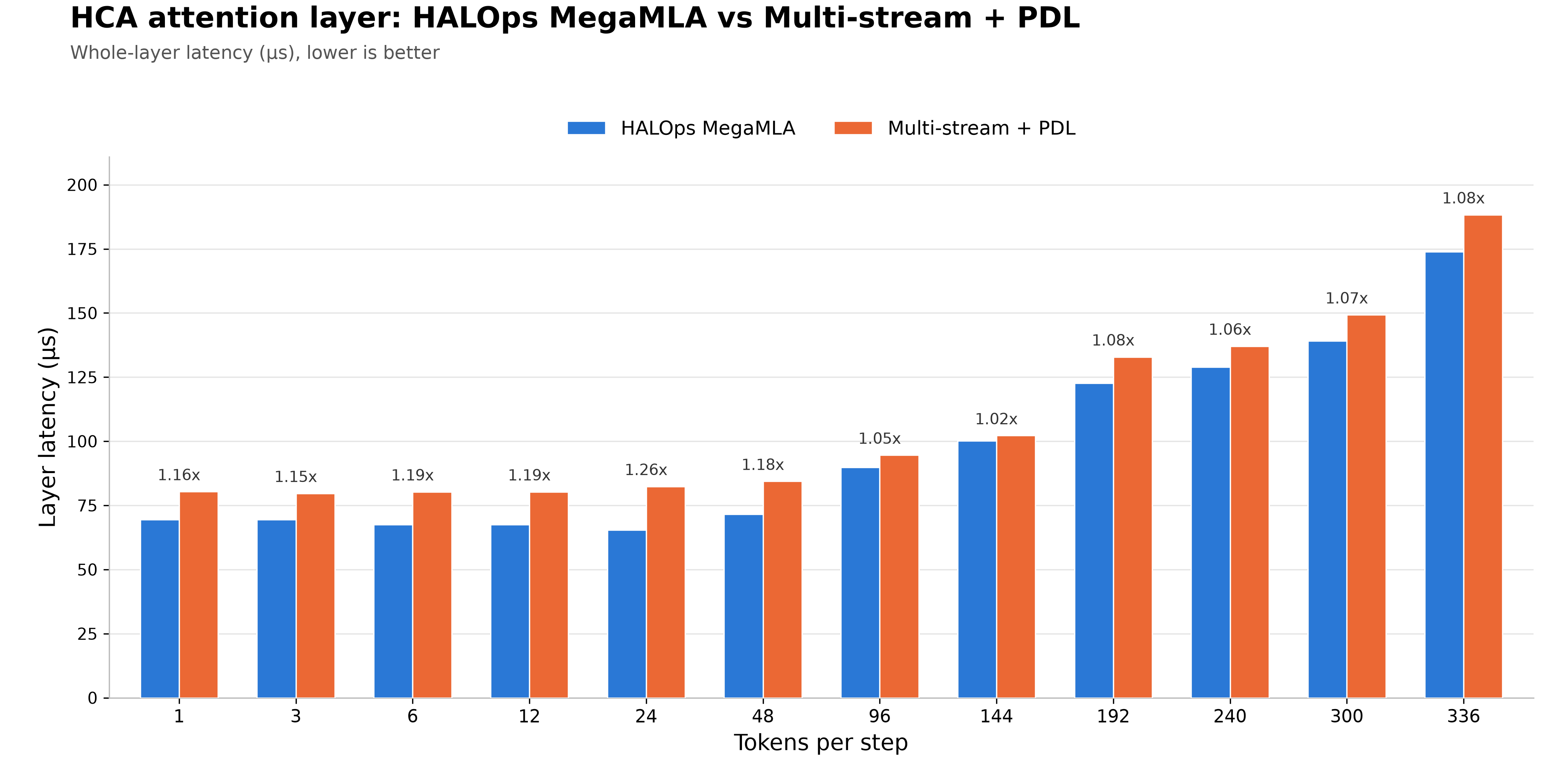 |
| Figure 1: Dense Mxfp8 W8A8 GEMM performance comparison | Figure 2: HCA attention layer performance comparison |